
Why Your Child Isn’t Overreacting: Understanding what’s really happening in your child’s brain during a meltdown and what they actually need from you in that moment.
It starts without warning.
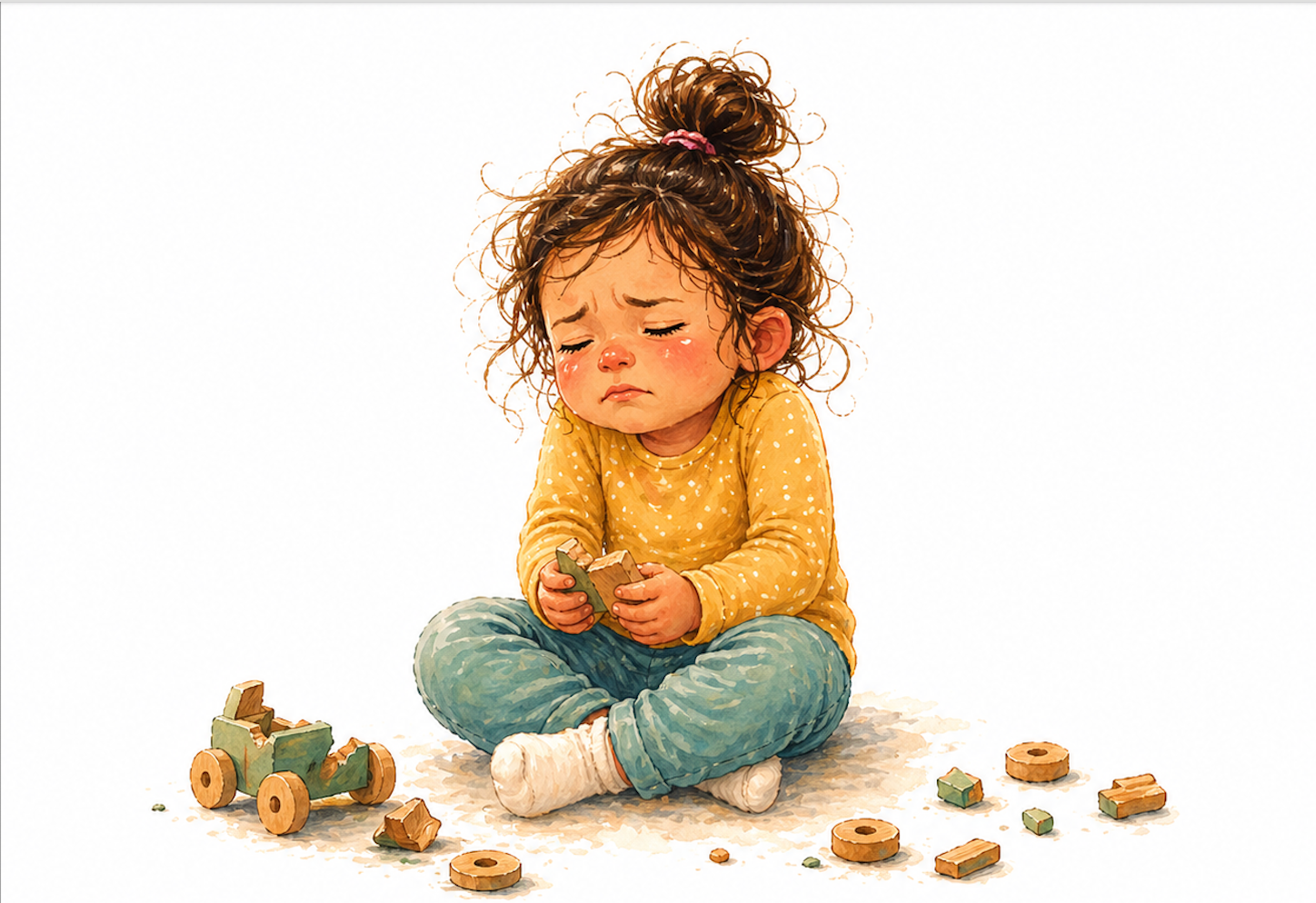
One moment everything is fine. The next, your child is on the floor, crying over something that — from where you’re standing — seems impossibly small. A broken biscuit. The wrong colour cup. A toy that won’t work.
And you’re standing there thinking: why is this such a big deal?
Here’s what I want you to know: your child isn’t being dramatic. They’re not manipulating you. They’re not even choosing this.
They’re overwhelmed. And there’s a very real reason why.
What's actually happening in their brain
Children’s brains are still developing — and one of the last parts to fully mature is the prefrontal cortex. This is the part responsible for logic, reasoning, impulse control and emotional regulation. In fact, it doesn’t fully develop until the mid-twenties.
What children do have — fully online and firing from birth — is the amygdala. The survival brain. The part that detects threat and reacts fast.
So when something goes wrong in your child’s world, even something that seems tiny to you, their survival brain fires first. Hard and fast. And in that moment, the thinking, calming part of their brain? It goes offline.
This is why reasoning doesn’t work mid-meltdown. Why “calm down” lands on deaf ears. Why explaining, correcting and negotiating all feel like talking to a wall.
It’s not defiance. It’s neuroscience.
Their body feels it before their brain can explain it
Here’s something that shifted everything for me.
A child experiencing a big emotional response feels it in their body first — before they can understand it, before they can name it, before they can manage it. Their heart races. Their chest tightens. Their whole system is flooded.
And they have no words for any of it.
What they need in that moment isn’t a lesson. It isn’t a consequence. It isn’t a calmer explanation of why they should feel differently.
They need a regulated adult.
Research in interpersonal neurobiology — pioneered by Dr Daniel Siegel — shows that a child’s nervous system literally co-regulates with the adult beside them. When you stay calm, their system begins to follow. When you escalate, theirs does too.
Your presence is not passive. It is the intervention.
What happens when we get it wrong — and why it's not your fault
Here’s the honest part.
When our children are dysregulated, we often become dysregulated too. That’s not weakness. That’s two nervous systems in the same room, both flooded, neither able to reach the other.
If you’ve ever said something you regretted in the heat of a tantrum — you’re not a bad parent. You’re a human parent who needed support that nobody gave you.
When a child’s big feelings are consistently met with shutdown, rushing or correction, they learn something quietly devastating: my feelings are too much. I shouldn’t feel this.
Over time, that becomes a belief. And that belief shapes everything — how they handle frustration, how they manage relationships, how they see themselves when things go wrong.
But here’s the good news.
These moments are opportunities — not failures
Every single meltdown is a chance to wire your child’s brain for resilience.
Not by getting it perfect. Not by having the right words every time. But by showing up. Staying present. Offering safety when their world feels like it’s falling apart.
A child who is consistently met with calm connection in their hardest moments learns something that will carry them for life:
I can feel hard things. And I’ll be okay.
That’s not just good parenting. That’s the foundation of emotional health, confidence and resilience.
Ready to go deeper?
Understanding this is one thing. Knowing what to actually do in the moment — consistently, even when you’re tired, even when you’re triggered — that’s where the real work happens.
That’s exactly what we explore in the Train a Child workshop.
You’ll learn how to regulate yourself first, how to respond instead of react, and how to turn your child’s hardest moments into their greatest lessons.
→ Join the next workshop at trainachild.com
You don’t need to be a perfect parent. You just need the right tools. 🤍
Tags